Are Rural Dental Practices More Profitable?

Co-Founder, Minty Dental

In Summary
- Rural practices sell for 50-66% of collections versus 85-100% urban — a $700k practice costs $350-460k rural versus $595-700k urban, creating $150-240k less debt from day one
- Operating overhead runs 50% rural compared to 75-80% urban, driven by lower rent, staffing costs, and minimal marketing expenses
- Lower acquisition cost plus lower overhead means a rural practice collecting $600k can net $300k before debt service while an urban practice at $800k nets only $176k
- Building ownership is accessible due to lower property costs, converting rent into equity and locking in fixed occupancy expenses
- Verify actual overhead over three years, compare to regional benchmarks, and assess whether the seller owns the building — these numbers determine whether the advantage is real
Lower Overhead and Acquisition Costs Create Faster Payback
The financial case for rural practice ownership starts with two structural advantages: you pay less to get in, and you pay less to operate.
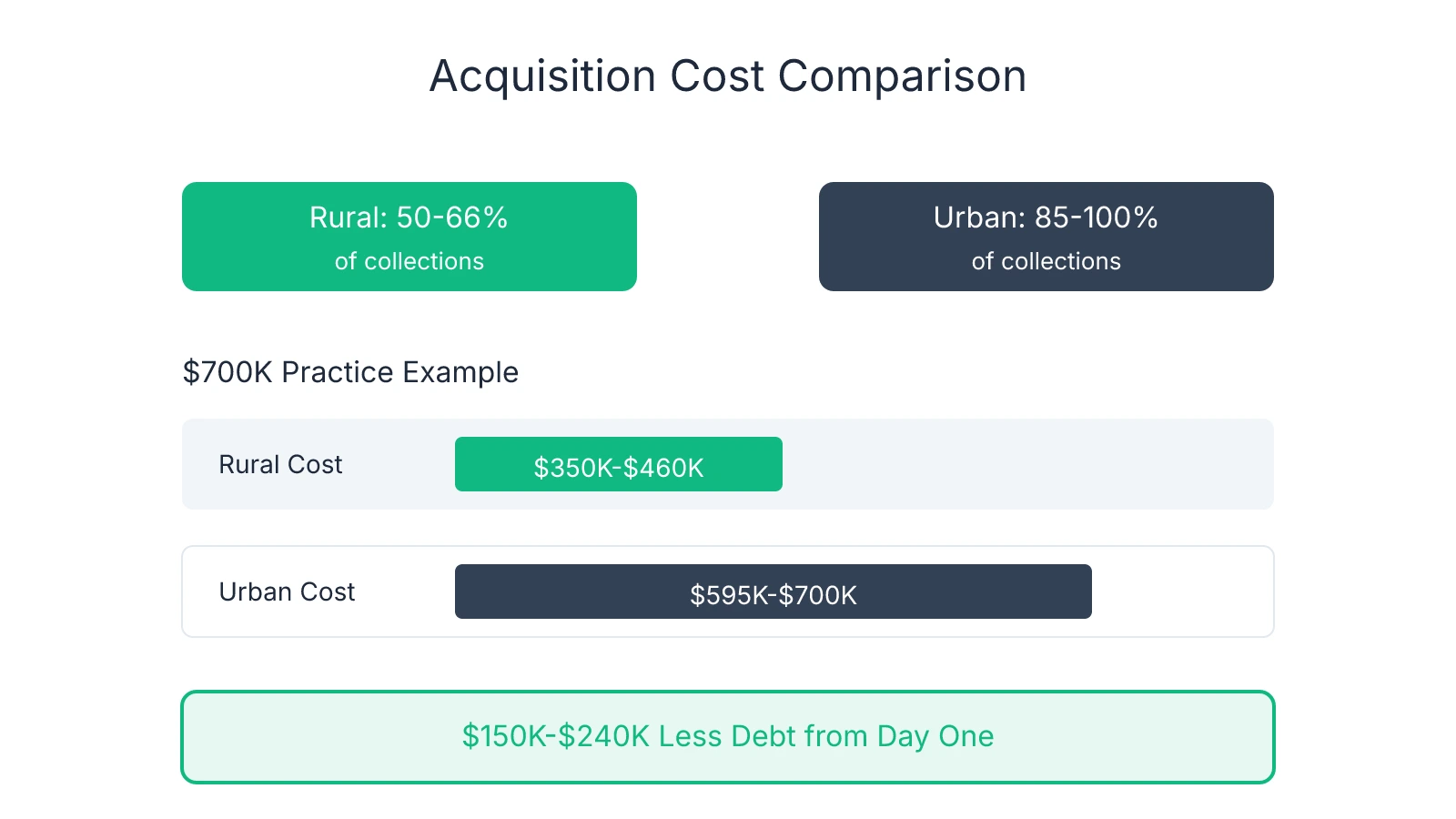
Rural practices typically sell for 50-66% of collections, compared to 85-100% urban. A practice collecting $700,000 annually might cost $350,000-$460,000 rural versus $595,000-$700,000 urban. You're starting with $150,000-$240,000 less principal to service — lower monthly payments and faster equity accumulation.
The advantage compounds in operating expenses. Rural overhead often runs around 50%, while urban practices hit 75-80%. Office space might run $2,000-$3,000 monthly rural compared to $8,000-$12,000 urban. Hygienist and assistant wages tend to be 20-30% lower, and patient acquisition costs drop when competition is limited and word-of-mouth dominates.
Building ownership is often accessible. Many rural practices include the option to purchase the real estate, either initially or shortly after. Lower property costs make this feasible earlier, converting rising rent into fixed mortgage payments and long-term equity. When you own the building, occupancy becomes controlled rather than variable — and you're building an asset that appreciates independently.
The math compounds quickly. A rural practice collecting $600,000 with 50% overhead nets $300,000 before debt service. An urban practice collecting $800,000 with 78% overhead nets $176,000. The rural buyer takes home more despite lower gross revenue — and services a smaller loan, accelerating payoff and increasing discretionary income.
During due diligence, verify actual overhead over three years. Pull P&L statements and calculate total operating expenses as a percentage of collections. Industry data shows rural practices maintain lower overhead, but individual practices vary. If the seller claims 50% but numbers show 65%, that gap represents risk you'll inherit. What buyers often miss is that overhead can drift upward post-transition if the seller's personal relationships were keeping costs artificially low.
Assess whether the seller owns the building and will sell it alongside the practice. If they plan to retain ownership and lease back, calculate what that rent costs relative to a mortgage on comparable property. Buying the real estate — even requiring a separate loan — often creates better long-term economics than signing a lease with annual escalations.
Compare the practice's sale price to recent area transactions. If regional rural practices sell at 55-60% of collections and this one is priced at 75%, renegotiate or understand what justifies the premium. The lower acquisition multiple is part of the structural advantage — paying urban multiples for a rural practice breaks the financial model.
The takeaway: lower entry cost and operating expenses create faster debt payoff and higher take-home income, but only if the numbers hold. Verify collections are real, confirm overhead is sustainable, and assess the real estate opportunity.
Less Competition Means Better Insurance Leverage and Patient Retention
Lower provider density in rural communities translates into negotiating power with insurance companies, lower patient acquisition costs, and stronger retention.
When you're one of two or three dentists serving a community, insurance companies need you more than you need them. Many rural practices negotiate higher reimbursement rates or more favorable terms because insurers can't exclude the only in-network provider within 30 miles. This is particularly true for Medicaid — if you're the only dentist accepting state coverage, you're positioned to negotiate rates that would be non-starters in competitive markets.
Patient loyalty tends to be stronger. Patients stay with the same dentist for years and refer family members, creating predictable revenue without expensive marketing. Where urban practices might spend $30,000-$50,000 annually on digital advertising, rural practices often grow organically through word-of-mouth.
Limited specialist access means general dentists retain procedures typically referred out in cities — endodontics, extractions, implant placement, complex restorative work. This broader scope increases per-patient revenue and keeps production in-house. A rural practice collecting $600,000 might generate that from 1,200 active patients, while an urban practice needs 1,800-2,000 to hit the same number.
These competitive advantages only hold if fundamentals are sound. One risk is insurance dependency. If 70% of revenue comes from a single insurance contract, you're exposed if that carrier renegotiates or drops the practice. Request a breakdown of collections by payer — ideally, no single plan should represent more than 30-40% of revenue.
Assess new patient flow trends over three years. A loyal patient base is an asset, but if the practice isn't attracting younger patients, you're inheriting an aging demographic that will gradually age out. Pull new patient reports by year and calculate average age. If median age is 55+ and trending upward, the practice may not be reaching the next generation.
Your clinical skill set matters more in rural markets. If the practice generates significant revenue from molar endo or surgical extractions and you're not comfortable performing those procedures, you'll either refer them out — losing revenue — or invest in continuing education. Ask the seller which procedures they perform in-house versus refer out, and compare to your current capabilities.
Verify the seller's role in patient retention. If the seller's personal relationships are the primary reason patients stay, you need structured transition support. Ideally, the seller remains involved for 60-90 days post-close, introducing you to patients and reinforcing continuity.
What the Numbers Don't Show: Payer Mix and Population Trends
A practice can show strong collections and low overhead but still carry hidden risk if underlying economics depend on factors outside your control. Two variables determine whether rural profitability is sustainable: payer mix and population trajectory.
Rural areas often have higher Medicaid populations, affecting both reimbursement rates and collection percentages. Medicaid typically reimburses at 40-60% of private insurance rates with more burdensome administrative requirements. If 50% or more of revenue comes from Medicaid, calculate what that means for actual take-home after adjusting for lower reimbursement and higher claim rejection rates.
Request a payer mix breakdown for three years — percentage of revenue from PPO, Medicaid, Medicare, and fee-for-service. A balanced mix might look like 50-60% PPO, 20-30% Medicaid, 10-15% Medicare, and 10-15% fee-for-service. If Medicaid exceeds 40%, assess whether the practice has optimized case acceptance to offset lower reimbursement, or whether it's accepting high volume at low margins.
Verify collection rates by payer type. Pull aging reports and calculate what percentage of billed services actually gets collected for each insurance category. Many rural practices show strong gross production but weaker collections because Medicaid claims take longer to process and denial rates run higher.
Population trends matter more than current size. A town of 8,000 growing at 2% annually offers different potential than a town of 12,000 losing 1% per year. Rural communities near expanding metro areas — exurbs within 30-45 minutes of a city — often see steady growth as housing costs push families outward.
Pull Census data or local economic development reports to assess five-year population trends. Look for net migration patterns, not just birth rates. Also assess proximity to economic anchors — a hospital, university, or major employer. These institutions stabilize population and create a base of insured patients with steady income.
Demographic composition affects treatment acceptance and revenue per patient. Median household income and age distribution tell you whether the community can afford comprehensive treatment. A rural area with median income above $60,000 and median age of 38-45 will generate different revenue per patient than one with median income of $40,000 and median age of 55+.
Assess untapped capacity. A practice collecting $600,000 on a four-day schedule with no evening hours and underutilized hygiene has room to grow. Calculate current production per clinical hour and compare to what's possible if you added a fifth day, extended hours, or hired a second hygienist.
Also assess whether the current owner has maximized case acceptance. Pull treatment plan acceptance rates for the past year. If only 40-50% of proposed treatment is being accepted, that's an opportunity — but only if the issue is presentation rather than affordability. Ask the seller how they present treatment and whether they offer financing options.
One risk is over-reliance on a single demographic cohort. If 60% of active patients are over 65 and the practice isn't attracting younger families, you're managing a declining asset. Request an age distribution report for active patients and compare to the community's overall demographics.
The decision framework: a rural practice is sustainable if it has balanced payer mix (no single source over 40%), stable or growing population with economic anchors, demographics that support treatment acceptance, and untapped capacity you can realistically capture. If any of those variables are unfavorable and outside your control, that's a reason to walk away.
Running the Actual Profitability Calculation
The question isn't whether rural practices are profitable in theory — it's whether this specific rural practice will generate more take-home income than the urban alternative you're considering.
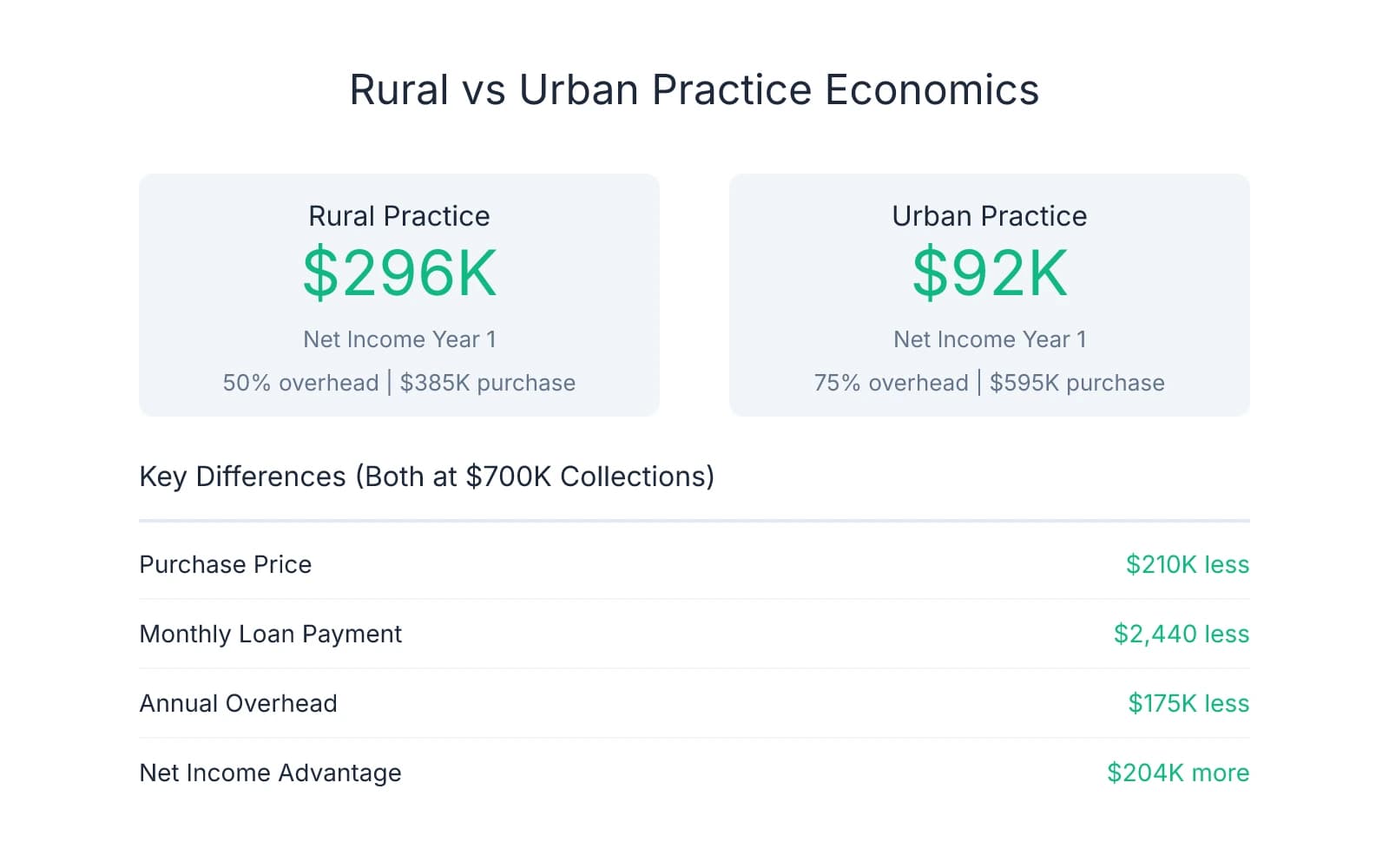
Start with two practices collecting $700,000 annually. The rural practice is priced at $385,000 (55% of collections), while the urban practice is listed at $595,000 (85% of collections). Financing both at 7% over 10 years, the rural loan costs $4,470 monthly; the urban loan costs $6,910. That's a $2,440 monthly difference — $29,280 annually — before you've treated a single patient.
Now apply overhead. The rural practice runs at 50% ($350,000 annually), leaving $350,000 before debt service. Subtract the $53,640 annual loan payment, and you net $296,360. The urban practice runs at 75% overhead ($525,000), leaving $175,000 before debt service. Subtract the $82,920 annual loan payment, and you net $92,080. Same gross collections. The rural practice puts $204,280 more in your pocket in year one.
Factor in cost of living. If the urban practice is in a market where median home prices are $500,000 and the rural market averages $250,000, your housing costs alone could absorb $2,000-$3,000 more monthly in the city. That $92,080 net income doesn't stretch as far when rent, childcare, and commuting costs are higher.
Consider whether the rural practice includes building ownership. If the seller owns the property and will sell it for $200,000-$300,000, you're converting rent into mortgage payments and building a second asset. Lower property costs often make it feasible to acquire both practice and real estate within the first few years.
The lifestyle calculation matters as much as the financial one. A 15-minute commute versus 45 minutes saves 10 hours weekly. Lower patient volume with higher per-patient revenue often means less burnout and more clinical satisfaction.
The trade-offs are real. Rural markets typically grow slower, which means your $700,000 practice may take longer to scale to $1 million. Continuing education opportunities are less accessible locally. If you plan to build a multi-location group practice, rural markets offer fewer expansion opportunities. From associate to owner takes less time in rural areas because acquisition costs are lower, but the ceiling on practice value may also be lower when you're ready to exit.
Run this calculation for every practice you're seriously considering. Plug in the actual acquisition price, verified overhead from P&L statements, and realistic debt service terms. Compare net income after debt service, then adjust for cost of living. The problems every buyer faces apply equally to rural and urban practices.
The decision isn't rural versus urban — it's whether this specific practice, in this specific market, generates the income and lifestyle you're optimizing for. Run the numbers. Factor in the non-financial variables. Then choose based on what the math and your priorities tell you.
Sources & References
The data and claims in this article are drawn from the following sources. We prioritize government data, peer-reviewed research, and established industry publications to ensure accuracy.
- Want a Lucrative Practice With Great Work-Life Balance? Go Rural!— www.ada.orgIndustry
- Rural vs City Dental Practice: Pros and Cons - Treloar and Heisel— treloaronline.com
- Pros of Owning a Rural Dental Practice— www.menlotransitions.com
Find Your Profitable Rural Practice Today
Rural dental practices offer exceptional returns on investment with lower overhead costs. Explore available rural practice listings and discover how to build a thriving, profitable practice in an underserved market.